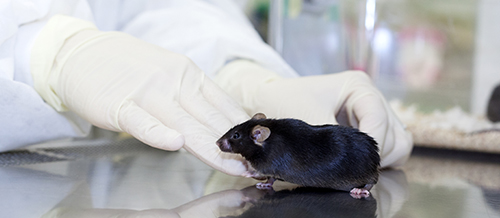
Use of Animals in Research
Overview
The use of animals in VA research is a privilege granted to those investigators and programs that commit to meeting the highest ethical and regulatory standards. VA animal care and use programs must follow VA policy on the use of animals found in Handbook 1200.7, "Use of Animals in Research", which incorporates compliance with USDA Animal Welfare Act Regulations and PHS Policy. All VA animal care and use programs are accredited by the Association for Assessment and Accreditation of Laboratory Animal Care (AAALAC, International). VA places great emphasis on the importance of the Institutional Animal Care and Use Committee (IACUC) in self-regulation and accountability of local programs. ORD support for field animal care and use programs is coordinated by the office of the Chief Veterinary Medical Officer (CVMO).
Mission and Activities
The primary mission of the CVMO's office is to provide professional and administrative guidance and support to VA field animal care and use programs. This is accomplished by phone and email consultations, periodic training sessions, and development of web-based support systems. IACUC support and training site visits to local programs can be arranged. A variety of representative documents are available, including memoranda of understanding with affiliates, VMO and animal facility supervisor position descriptions, and animal facility standard operating procedures. The CVMO provides a yearly summary of VA animal research issues at the annual meeting of the American Association of Laboratory Animal Science (AALAS), typically on the Tuesday of the meeting at noontime. The office also provides support for research staff experiencing difficulties using the CITI website for research compliance training.
top
Contacts |
| CVMO: |
Michael T. Fallon, DVM, PhD, DACLAM, CPIA
Atlanta VA Medical Center
Research Service- 508/151V, Room 4A106
1670 Clairmont Road
Decatur, GA 30033
|
michael.fallon@va.gov
404-327-4964 (FAX)
404-728-7644 (Ofc)
|
| Staff Scientist and Deputy, IACUC Guidance: |
Alice Huang, PhD, CPIA
Atlanta VA Medical Center
Research Service- 508/151V, Room 4A107
1670 Clairmont Road
Decatur, GA 30033 |
alice.huang@va.gov
404-327-4964 (FAX)
404-417-1823 (Ofc)
|
| Assistant CVMO: |
Joan Richerson, MS, DVM, MS, DACLAM, CPIA
Tennessee Valley Healthcare System
Research Service- 151, F-201 ACRE Bldg.
1310 24th Ave South
Nashville, TN 37212 |
joan.richerson@va.gov
615-752-5018 (FAX)
615-574-8198 (Ofc)
|
At the VA-VMO luncheon on October 4, 2011, the following PowerPoint slides were presented regarding the 8th edition of the Guide for the Care and Use of Laboratory Animals (Guide). The second document is a table of the "must,""should," and "may" statements found in the 8th edition of the Guide.
top
Important Documents
Use of Animals in Research - VHA Handbook 1200.07 (418 KB, PDF)
Forms for Semiannual Evaluations of the Institutional Care and Use Program and Facilities
Each row in the table below shows a version of the set of forms
used for reporting on the Semiannual Evaluations performed by VA IACUCs. Please be sure to use the current version
of the forms for each Semiannual Evaluation; for each report, complete all four of the documents, which are available via the links in first row of
the table.
Version Date
|
Form
|
Comments
|
Status
|
2/28/2013
2/28/2013
2/28/2013
2/28/2013
|
VA Semiannual Evaluation of the Institutional Animal Care and Use Program and Facilities
Part 1 – Checklist (Section A)
Part 1 – Checklist (Section B)
Part 2 – Table of Deficiencies and Departures
Part 3 – Post-Review Documentation
|
Minor update with clarifications and corrections
|
Current version
, begin use as soon as possible, required for evaluations completed after 9/30/2013
|
5/10/2012
5/10/2012
5/10/2012
|
VA Semiannual Evaluation of the Institutional Animal Care and Use Program and Facilities
Part 1 – Checklist (Sections A and B)
Part 2 – Table of Deficiencies and Departures
Part 3 – Post-Review Documentation
|
Major update to incorporate the provisions of the 8th edition of the Guide and document "departures"
|
May be used for evaluations completed before 9/30/2013
|
April 2011
April 2011
April 2011
|
VA IACUC Semi-Annual Self-Review Forms
Form 1. Checklist (Parts A and B)
Form 2. Table of Program and Facility Deficiencies
Form 3. Post Review Documentation
|
Includes new features in response to review of VA animal programs by OIG (e.g., table of work orders)
|
No longer in use, as of 11/30/2012
|
February 2011
February 2011
February 2011
|
VA IACUC Semi-Annual Self-Review Forms
Form 1. Checklist (Parts A and B)
Form 2. Table of Program and Facilities Deficiencies
Form 3. Post-Review Documentation
|
Interim update
|
No longer in use, as of 10/31/2011
|
October 2005
October 2005
October 2004
|
VA IACUC Semi-Annual Self-Review Forms
Form 1. Checklist (Parts A and B)
Form 2. Table of Program and Facilities Deficiencies
Form 3. Post-Review Documentation
|
|
No longer in use, as of 8/31/2011
|
top
Animal Component of Research Protocol
Each row in the table below shows a version of the ACORP used for documenting protocols for review by the IACUC.
Please begin using the current version as soon as possible; the current version will be required for any work that will
be reviewed by the IACUC after February 1, 2014, for submission in support of an application for VA funding. For each protocol, complete the Main Body and
all applicable Appendices; the forms and instructions are available via the links in the first row of the table.
Version Number
|
Form
|
Comments
|
Status
|
|
4
|
Animal Component of Research Protocol (ACORP)
Main Body
(ACORP Instructions)
Appendix 1
– Additional Local Information
(ACORP App. 1 Instructions)
Appendix 2
– Antibody Production
(ACORP App. 2 Instructions)
Appendix 3
– Biosafety
(ACORP App. 3 Instructions)
Appendix 4
-- Ante-mortem Specimen Collection
(ACORP App. 4 Instructions)
Appendix 5
– Surgery
(ACORP App. 5 Instructions)
Appendix 6
– Special Husbandry and Procedures
(ACORP App. 6 Instructions)
Appendix 7
– Use of Patient Care Equipment or Areas for Animal Studies
(ACORP App. 7 Instructions)
Appendix 8
– Use of Explosive Agent(s) within the VMU or in Animals
(ACORP App. 8 Instructions)
Appendix 9
– Departures from "Must" and "Should" Standards in the Guide
(ACORP App. 9 Instructions)
|
Major update from Version 3
Separate expanded instructions – with references and examples
|
Current version
, begin use as soon as possible, required for any protocol submitted to the IACUC for initial or triennial review after 2/1/14
|
|
3
|
Animal Component of Research Protocol (ACORP)
Appendix 1 – Use of a Non-VA Facility to House Animals Purchased with VA or VA Research and Education Corporation Funds
Appendix 2 – Antibody Production
Appendix 3 – Test Substances
Appendix 4 -- Antemortem Specimen Collection
Appendix 5 – Surgery
Appendix 6 – Special Husbandry and Procedures
Appendix 7 – Request to Use Patient Care Procedural Areas for Animal Studies
Appendix 8 – Request to Use of Explosive Agent in the Animal Facility or in Animals
Appendix 9 – Additional Local Information
|
Major update from version 2/2a
|
May be used for protocols submitted to the IACUC before 2/1/14
|
|
2a
|
|
|
No longer in use, as of 1/1/2005
|
|
2
|
|
|
No longer in use, as of 1/1/2005
|
top
Required training for staff involved in the use of animals in research
VA web-based training requirements for animal research are found in section 8.m of VHA Handbook 1200.07, "Use of Animals in Research." Training must be renewed at intervals of no more than two years to demonstrate compliance with Federal animal research training mandates. The web courses listed below are available free of charge to all VA programs at both the CITI website and the AALAS website through agreements. Contact the CVMO for more information about which site would best meet your needs.
Required training is as follows:
1.
IACUC Members and IACUC support staff (IACUC administrators, coordinators, etc). Personnel that serve on or provide support to either a VA Institutional Animal Care and Use Committee (IACUC) or an affiliate IACUC that serves as the IACUC of record for a VA program must take the following web-based training at least biennially:
top
top
2. Personnel who participate in or supervise research that involves laboratory animals. If personnel participate in or supervise animal procedures conducted at the VAMC, work with animals purchased with VA funds regardless of performance location, or work with animals during VA duty hours, regardless of location, they must complete the following web-based training at least biennially:
- Working with VA IACUC (the non-VA version of the course may be acceptable in some situations; contact the CVMO as needed)
They must also complete at least biennially each species-specific course that is relevant to their work:
- Working with Cats in Research Settings
- Working with Dogs in Research Settings
- Working with Rats in Research Settings
- Working with Mice in Research Settings
- Working with Guinea Pigs in Research Settings
- Working with Rabbits in Research Settings
- Working with Hamsters in Research Settings
- Working with Gerbils in Research Settings
- Working with Swine in Research Settings
- Working With Non-Human Primates in Research Settings
- Working with Amphibians in Research Settings
- Working with Ferrets in Research Settings
If your station wants to utilize alternate training to satisfy VA training requirements, please contact the CVMO. The station will be asked to document of how each item addressed in the CITI courses above will be covered in the alternate training. Education goals for web-based training will be considered met when personnel are able to pass an exam that covers important topics in the training. The exam must be of sufficient difficulty to provide some assurance that important concepts have been learned. Alternate training will only be acceptable if approved by the CVMO.
top
3. Animal care staff. Animal care staff members should receive training appropriate for their responsibilities, and consistent with the training commitments in both the AAALAC Program Description and PHS Assurance. Some stations utilize the web coursework in item number 2 as part of the overall training program, but this is not a requirement in VA policy.
top
Guidance on Animal Research FOIA Requests
On January 30, 2013, VHA issued updated guidance to FOIA Officers (1.6 MB, PDF) on FOIA requests related to animal research. Please notify the CVMO's office immediately if your station receives such a request.
Animal Facility (Veterinary Medical Unit) renovation and construction design manuals
The VA Office of Construction & Facilities Management provides mandatory construction and renovation standards for VA animal facilities. The following design manuals that impact VA animal facilities are available in PDF format at http://www.cfm.va.gov/til/dManual.asp:
- Architectural Design Manual, August 2011, 76 pages, see section 4.33.2.
-
TIL Design and Construction Procedures (PG-18-3), see "Topic 6 - Floor Slab Depressions".
-
TIL Technical Summaries, see section on "Research", which contains the document "HVAC Requirements in Animal Facilities".
- HVAC Design manual for New, Replacement, Addition, and Renovation of Existing VA Facilities, March 2011, see Animal Research and Holding Areas, pp. 6-19 through 6-26
Some of the design manuals above reference sections in the 1993 Veterinary Medical Unit (VMU) VA Design Guide, which remains an important source of VA animal facility design criteria. This 1993 design guide is also available on the TIL Design Guides (PG-18-12), see section on "Veterinary Medical Unit"."
top